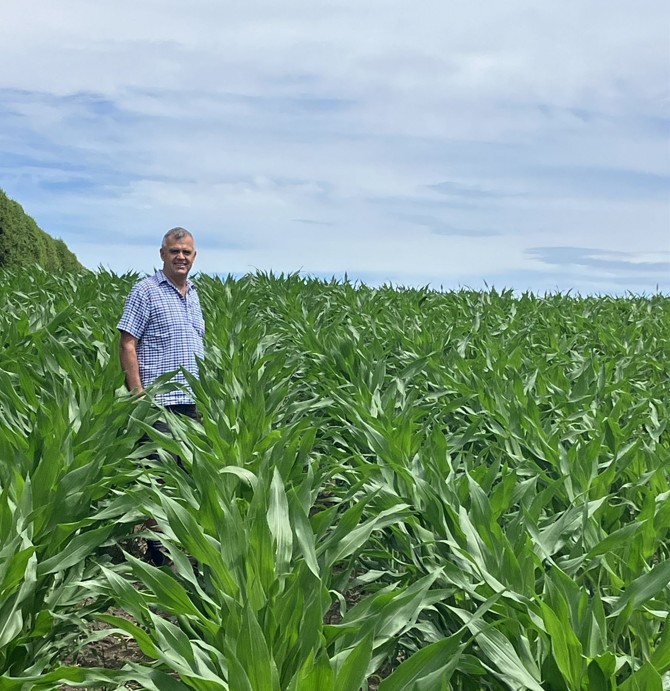
At ReviveAg, we’ve pushed boundaries in maize silage production in the Bay of Plenty over the last four years. Working alongside progressive contractor Jordaan Contracting from Paengaroa, we brainstormed ideas, made mistakes, and tested new approaches. After the last season, we can confidently say we’ve moved the dial on efficiency, yield, and quality.
What problem were we trying to solve?
Jordaan Contracting has been growing maize silage and leasing land in the Bay of Plenty for nearly 20 years. Over time, profitability became increasingly difficult. Yields had plateaued at around 22 t DM/ha, while input costs (fuel, fertiliser, and chemicals) kept rising faster than the returns from silage sales. On top of that, maize production in the BOP has been in decline for decades due to the expansion of kiwifruit orchards. This made economy of scale and land lease costs even more challenging.
These pressures are familiar to many New Zealand farmers right now.
Together we sat down and defined our shared values and strategy. Four core principles guided everything we did:
1. You can’t manage what you can’t measure We started with a full baseline soil study using grid sampling on a half-hectare grid. During the season we took plant sap analysis through NovaCropControl in the Netherlands to keep nutrient levels optimised in real time.
2. Grow more with less Blanket fertiliser applications weren’t delivering yield increases anymore. We introduced precision agriculture technology, including variable rate fertiliser applications and yield monitoring. Over four years, fertiliser cost per hectare has dropped significantly, while soil nutrient levels have become far more uniform across paddocks.
Japie recently said: “I could not believe how the uniformity of my crops has improved since we implemented variable rate technology.”
3. Shift from crop removal to maximising photosynthesis Instead of simply replacing nutrients removed by the crop (the common NZ approach), we focused on keeping the maize plant green and actively photosynthesising for as long as possible. We studied the plant’s phenological stages and tailored nutrient applications accordingly, timing nitrogen, sulphur, potassium, and key micronutrients (molybdenum, boron, cobalt) to match the plant’s needs.
The “Plant Health Pyramid” concept from John Kempf was incredibly helpful here. Yellowing plants at harvest are still common in the North Island, a clear sign this approach isn’t widely understood yet.
4. Treat the soil as a living ecosystem We moved beyond viewing soil as just a growth medium. Norman Higgins, Jordaan Contracting’s Production Manager, has studied soil biology and the Soil Food Web for decades. When we activated biological nutrient cycling, plant sap analysis showed higher available nutrients even in areas where less synthetic fertiliser was applied. Soil structure, compaction, water-holding capacity, and beneficial microbial life all improved dramatically.
So, did it work? Here’s the proof:
- Average maize silage yield increased from a stubborn 22 t DM/ha ceiling to 26 t DM/ha.
- Fertiliser costs per hectare decreased while soil fertility levels moved into optimum ranges (backed by three years of grid soil tests).
- Silage quality improved markedly. The plants stayed green right through to harvest (see photo below).
 small.jpg)
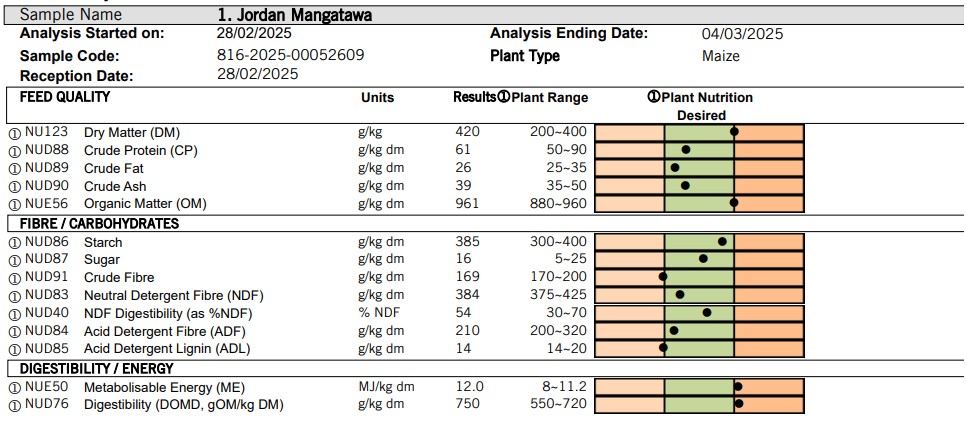
When we showed the analysis of one paddock to a well-respected New Zealand nutritionist, he said: “I think this is the best analysis of maize silage I have ever seen in NZ.”
(42% DM, 38.5% starch, 12 MJ/kg ME — full analysis in the image below.)
Arable farming in New Zealand is at a crossroads: high input costs, low commodity prices, and unpredictable weather. While there aren’t many levers left to pull, greater efficiency through precision agriculture and better biological management offers real hope.
We recently made a strategic shift at ReviveAg. We realised that on our own we can only help a limited number of farmers. By making our tools, knowledge, and 20+ years of experience more widely accessible, the potential impact is much greater.
If you’re a farmer or consultant who shares this vision, we’d love to hear from you. Feel free to reach out at www.reviveag.co.nz.